
твой дом мой дом

Image result for immigration

This coming November 11th will mark the seventeenth year since my parents decided to pack up their lives and take my sister and I from central Moscow across the world to Toronto, Canada. Moving to Canada provided a significant marker and though I do not remember much of life before the move, I will be forever grateful for the decision my family made and the country I am able to call home. It has allowed for unimaginable opportunities that everyone in my family has experienced that may have not been presented if they had not emigrated from Russia. Not only did this decision benefit myself and my parents, but it also meant that Canada would receive two working-class citizens and their children—future working-class citizens –adding to the economy and the future of the country.


Immigration is defined as the act of moving permanently to a foreign country. There are many contradicting views on immigration throughout North America and across the world. Immigration is a subset of globalization and is able to shape society into a multicultural nation through the developing diversity, economy, trade and business. “Popular immigration countries like the United States of America, Canada and Australia took advantage of this boost in productivity. By the early 20th century, these countries entered the world stage as forces to be reckoned with. At the same time, however, they made significant efforts to control these large migratory flows, in process inventing novel forms of bureaucratic control and developing new surveillance techniques designed to accumulate more information about nationals while keeping ‘undesirables’ out.” (Steger 34). This statement proves that immigration from a controlled standpoint is very positive and can act as a catalyst for development. It creates greater connections through people, goods and information through immigration into Canada. As an example, my father uses the skills and education that he acquired back in Russia here in his job in Canada.


In May of 2011 we saw how humanitarian crisis of astounding proportions can displace a population of 6 million Syrians out of a total of 23 million. “The massive refugee flows pouring out of Syria strained the available material resources of host communities and also created significant cultural tensions with domestic populations who saw these outsiders as a drain on their country’s economic resources” (Steger 68). Illegal immigration does not hold the same positive benefits that legal immigration does as it is usually composed of “squatters”. These are people who cannot get legal jobs, do not contribute to the economy and consume precious resources. Not only does this have repercussions but this creates a sense of global instability and upheaval. This situation enables strong feeling of responsibility and global citizenship.


Although many people associate immigration with negative generalizations, I personally believe that immigration holds a lot of value for individuals who are seeking different circumstances which can change their life for the better through globalization. Our decisions and actions have a wider global impact resulting from globalization and immigration, ultimately creating an obligation towards global citizenship.

Sign of the Times

Sense of global instability, illusions of upheaval and global consciousness, it’s a sign of the times. Not to regurgitate worn out boy band material, but Harry Styles puts it well, “Just stop your crying, have the time of your life, break through the atmosphere, and things are pretty good from here”. This is the same ideology that we have to adopt when rationally dealing with globalization. Some may call this concept ‘globaloney’ but that thinking essentially proves that globalization in its sense is subjective and searching for a universal definition is futile. However revolutionary globalization is within modern society, each individual directly affected by this concept will form personal opinions.

From my own experiences this is also evident within the free flow of ideas and the ability to share connections from all around the world. However, the common term of ‘globally’ is being distorted into the portmanteau ‘glocally’. This arising twist on the term describes the interconnection of global events felt on a local and personal level. The idea of ‘glocally’ can be seen through many media platforms such as The Wall Street Journal, Snapchat and Instagram (After all, we did see Kim Kardashian break the internet on a global scale). Most of the concepts that fall under globalization can initially be seen through the forefathers of the term, Thomas Friedman and David Held. Again irony can be seen through these individuals because they attempted the futile feat to create a universal definition.

IMG_0485

In saying this, I am no different than before or around me as I find myself creating my own definition of the term when I am caught in situations where I have to use my thoughts on globalization and think rationally about how it affects me. When in these situations I try to gain a broader perspective with the issue at hand. One of the prevalent cases of this occurring is with Donald Trump’s Auto Tariffs on Canada. This issue may have an everlasting effect on jobs and worker salaries directly affecting my immediate family as well as my future. The above picture illustrates the vehicle that my sister makes at the Cambridge factory. With these Tariffs you may not see this Vehicle and may more around. Trump is trying to imposing a 25% tax on imported vehicles into the United States from Canada. This is in respect to the proposed NAFTA negotiations from early August of 2018. As stated in an article from MacLean’s, “Thousands of people in central Canada would be out of work. The hit to Canada’s GDP could be enough to put Ontario—perhaps even the country—into a mild recession” (1). When asking ourselves what can be done about this issue the easiest method of coping for my family member may just be to find another place of employment; because running away from your problems always makes them go away, right? We now turn to what should be done. Financial Post puts this in perspective as, “The country has no choice but to respond in kind with counter-tariffs on U.S. autos and parts… it’s of no benefit to anybody, but how do you get a bully to back off when their foot is on your neck? Do you plead with them or do you bite the foot?” said Flavio Volpe, president of the Automotive Parts Manufacturers’ Association. “Not responding is not an option.” (2)  This is yet another example where the term “glocally” comes into play.

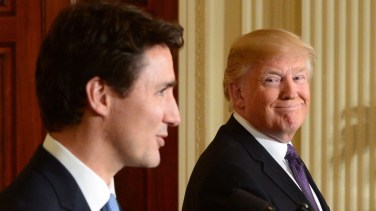
Referring back to my principles on globalization this shows a sense of instability and of upheaval but we have to ask ourselves who can and should decide the fate of the NAFTA agreement that can affect so many people. Cynical, right? That’s an easy one, Justin Trudeau and our pal Donald Trump will just have to battle it out this week.

t-and-t

  • Revolutionary globalization is within modern society
  • Glocally: of or relating to the interconnection of global and local issues, factors, etc.
  • Trump is trying to imposing a high tax on imported vehicles into the United States from Canada, causing many job losses
  • Canada must respond to the US NAFTA negotiations
  • Who can and should decide the fate of the NAFTA agreement?


(1) https://www.macleans.ca/economy/what-will-happen-if-trump-slaps-a-25-per-cent-tariff-on-canadian-made-cars/

(2) https://www.google.com/url?q=https://business.financialpost.com/transportation/autos/facing-trumps-auto-tariff-threat-canadas-response-isnt-so-clear&usg=AFQjCNFI_TbGB0ATB0xsGsqHmmnu7t22kA